
Guide
Cupping Marks and What to Expect From a Session
The circles are the part everyone recognizes and the part most sites get wrong. Here is what they are, inside a 60 or 90 minute session.
By Oregon Massage & Spa NewbergPublished Last updated
Where Cupping Marks Come From
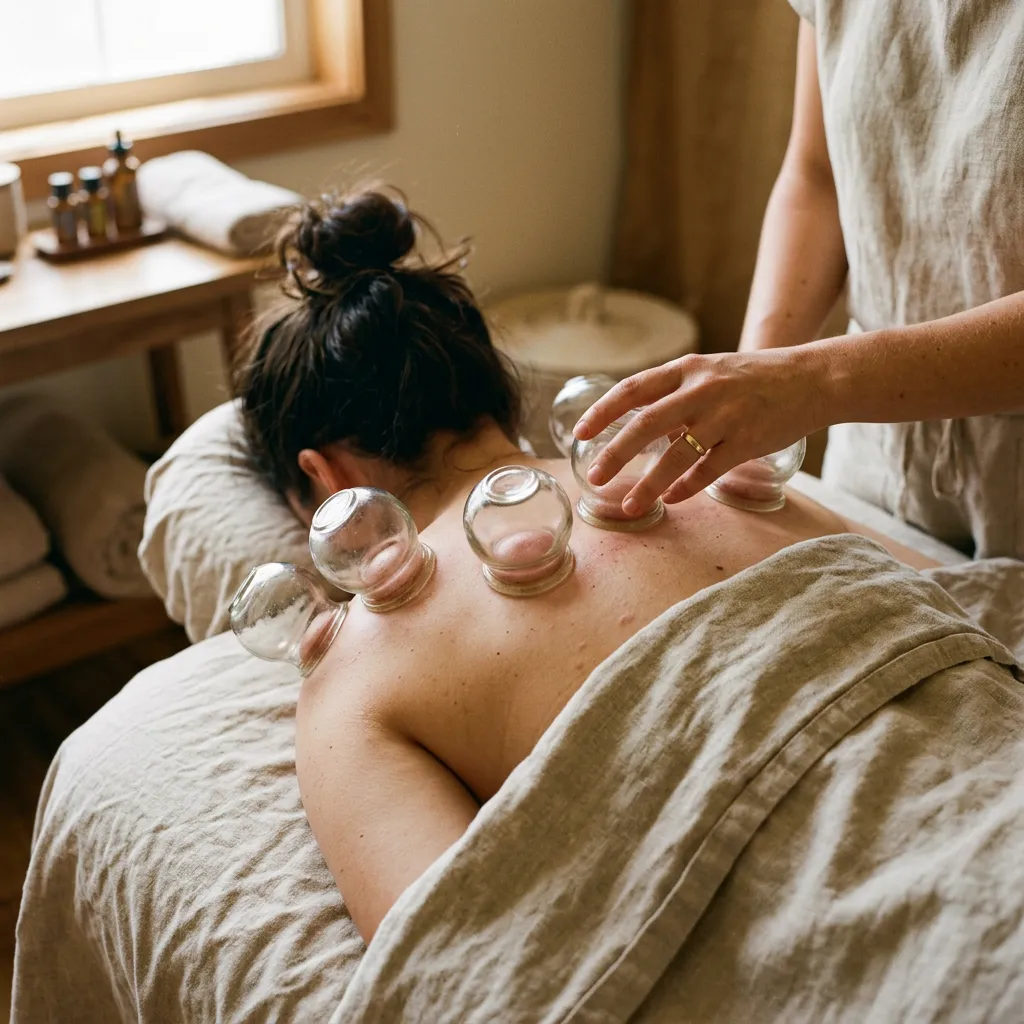
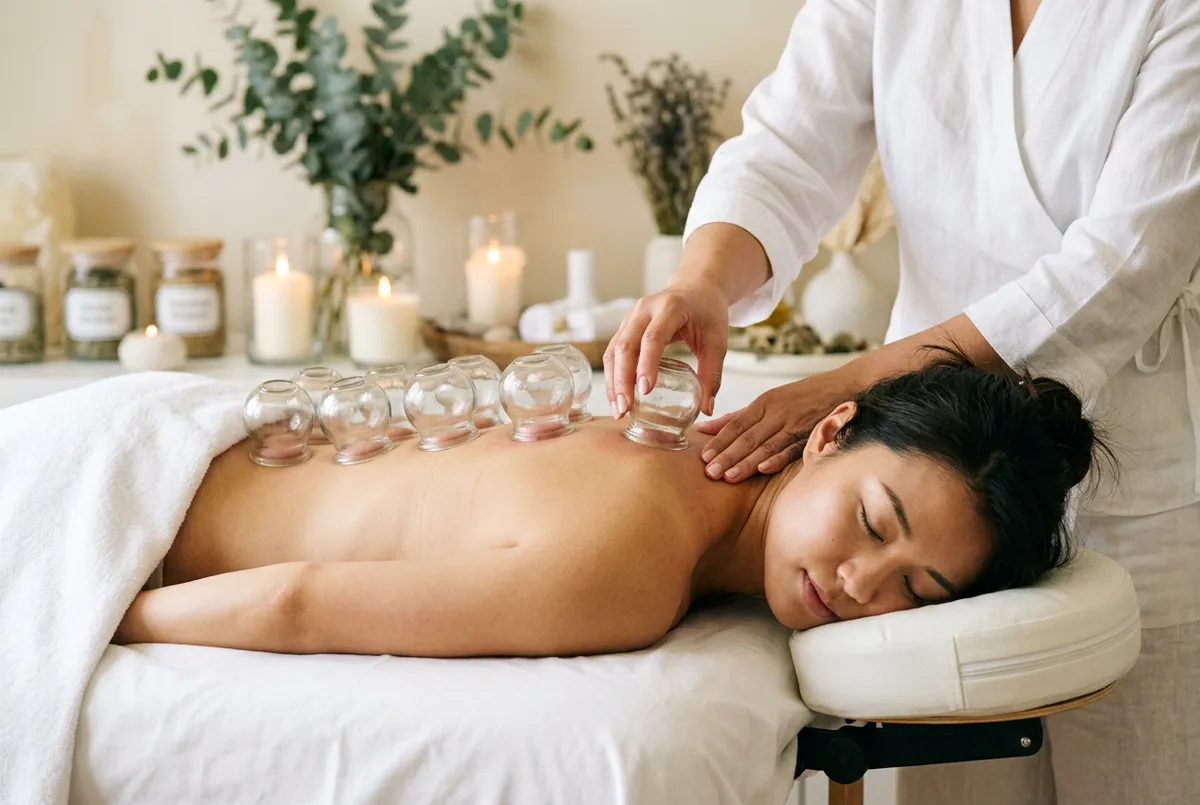
A cup is placed on the skin and the air inside it is removed, either by warming the cup with a flame or, far more commonly now, with a pump. The pressure inside drops, and skin plus the tissue just under it gets pulled upward into the cup. Small blood vessels near the surface give way, blood leaks into the tissue around them, and you are left with a flat round patch that traces the rim.
That is the entire mechanism. It is worth stating plainly because the alternative explanations are everywhere. Cupping marks are not toxins being drawn to the surface. They are not stagnation leaving the body. They are not a diagnostic readout of how much stress you have been carrying. They are blood outside a vessel, which is the same thing a bruise is.
How dark yours go tells you about your capillaries and about how much suction was used. It does not tell you how much you needed the session. Two people can get an identical treatment and walk out looking completely different.
How Long They Last, and How to Plan Around Them
Expect three days to two weeks. The marks follow the same arc as a bruise, going from red to purple to a yellowish green before disappearing. Nothing you apply will speed that up in any meaningful way, so the planning has to happen before the session rather than after it.
The practical advice is boring and it works. If you have a wedding, a holiday, a swim meet or a physical exam inside the next two weeks, either postpone the session or ask your therapist to keep the cupping marks where a shirt will cover them. Upper back and shoulders are easy to hide. Forearms and the back of the neck are not.
There is one more thing to do, and it matters more than it sounds. Mention the cupping to any doctor or nurse who sees your back. The National Center for Complementary and Integrative Health (NCCIH) raises this directly: the origin of the marks should be explained to your health care providers so they are not mistaken for signs of physical abuse. A clinician looking at rows of symmetrical circles with no context is doing their job when they ask questions. Save everyone the detour.
What the Evidence Says, and What the Silence Means
The National Center for Complementary and Integrative Health exists to evaluate practices like this one. Its cupping fact sheet lists no conditions that cupping treats and cites no trial showing that it works. Most of the page is given over to safety instead. When the agency built for this job declines to make a single benefit claim, that gap is the finding.
Read that carefully, though. It is not a verdict that cupping does nothing. It is a statement that the high-quality research needed to say either way has not been done. Whatever relief people report may owe a good deal to expectation, attention, and the plain comfort of lying still while somebody tends to your back. That is a real experience for the person having it. It is a different claim from a proven physiological effect.
Compare it to acupuncture
Acupuncture comes from the same tradition and has been studied far more heavily, which makes it a useful yardstick. There, NCCIH can describe an actual mechanism: studies suggest acupuncture stimulates the release of the body's natural painkillers and affects brain areas involved in processing pain. The results are still mixed, with some trials finding real and sham acupuncture equally effective. But there is something to argue about. Cupping does not have that yet.
Why "thousands of years old" settles nothing
Age gets offered as proof for cupping, and the tradition itself shows why that fails. Within traditional Chinese medicine, practices of similar vintage have fared completely differently under testing. Tai chi comes out reasonably well, with research suggesting it may improve balance in older adults and reduce knee osteoarthritis pain. Acupuncture lands in the mixed middle. Chinese herbal products remain unproven because the studies are too weak to conclude anything. Same tradition, same centuries behind each one, three different answers. Longevity tells you a practice is durable, not that it works.
Dry Cupping and Wet Cupping Are Not the Same Conversation
Dry versus wet is the single most important distinction in cupping, and NCCIH draws it in one line: in wet cupping the skin is pierced and blood flows into the cup, while dry cupping does not involve piercing the skin. That is a much bigger gap than the shared name suggests.
Dry cupping leaves a bruise. Wet cupping is a procedure that deliberately opens the skin and draws blood, which moves the risk from discoloration to open wound. Anemia from blood loss has been reported after repeated wet cupping. If a practitioner cannot tell you plainly which one they do, settle that before anything else. We only do dry cupping, as a +$30 add-on to a massage.
The documented side effects are worth knowing either way: persistent skin discoloration, scars, burns, infections, and worsening of eczema and psoriasis. Burns trace back to the fire method specifically. Bleeding inside the skull has been reported after cupping on the scalp, which is rare but is exactly why nobody should be cupping your head.
How to Judge a Cupping Practitioner
Cupping has no single credential behind it the way acupuncture does, which pushes more of the vetting onto you. These five questions cover the risks that actually appear in the literature, and any competent practitioner will answer them without hesitating.
- 1. Dry or wet? If the answer is wet, you are booking a procedure that breaks skin. Decide that on purpose, not by accident.
- 2. Single-use or sterilized cups? Cups pick up blood even in dry cupping. Reused equipment can pass on hepatitis B and C.
- 3. Fire or pump? Burns are on the documented side-effect list, and they come from the flame method.
- 4. What will you avoid? A good answer includes the scalp, broken skin, sunburn and any area with active eczema or psoriasis.
- 5. What are you claiming it does? If you hear detox, or a promise to cure something, you have learned what you needed to know.
Cupping Marks and Sessions: The Numbers
Most of what people want to know about cupping marks is a matter of timing and cost rather than theory. The table below collects those figures, alongside the studio details for booking cupping as a +$30 add-on to a massage in Newberg.
| Established | 2008 — over 17 years of experience in Newberg, Oregon |
|---|---|
| Client rating | 4.8 out of 5 stars from 558+ reviews |
| Session lengths | 30, 45, 60, 75, 90 and 120 minutes |
| Rates from | $60 for 30 minutes · $85 for 60 minutes · $125 for 90 minutes |
| Open | Monday–Saturday 9:00 AM – 8:30 PM · Sunday 9:00 AM – 7:00 PM |
| Address | 901 Brutscher St 208 (second floor), Newberg, OR 97132 |
| Phone | (503) 538-0100 |
| Add-ons | Hot Stone +$20 · Aromatherapy complimentary · Cupping +$30 |
| Insurance | Oregon personal injury protection (PIP), workers' comp, health savings account (HSA) and flexible spending account (FSA) cards · medical massage $15–$36 copay |
| Areas served | Newberg, Oregon (OR), plus six nearby cities: Dundee and McMinnville in wine country, Sherwood and Wilsonville a short drive away, and Tigard and Tualatin toward Portland |
| Marks last | 3 days to 2 weeks, fading through the same colors as a bruise |
| Cup time | A few minutes per placement, inside a 60 or 90 minute massage |
| Cupping add-on | +$30 on top of any massage — a 60 minute session is $85 |
| Method here | Dry cupping only. No flame, nothing pierced, never the scalp |
| Documented risks | Discoloration, scars, burns, infection, worsening eczema or psoriasis |
| Evidence level | Low — 0 conditions listed and 0 trials cited on the NCCIH fact sheet |
Session lengths and rates
The full rate ladder, in the same order the booking page lists it. Every service is priced per session with no membership or contract.
| Service | Session lengths | Rates |
|---|---|---|
| Swedish / Relaxation Massage | 30 min / 45 min / 60 min / 75 min / 90 min / 120 min | $60 / $70 / $85 / $100 / $125 / $180 |
| Deep Tissue Massage | 30 min / 45 min / 60 min / 75 min / 90 min / 120 min | $60 / $70 / $85 / $100 / $125 / $180 |
| Couples Massage | 60 min / 75 min / 90 min / 120 min | $170 / $200 / $250 / $360 |
| Prenatal Massage | 60 min / 75 min / 90 min | $110 / $135 / $160 |
| Reflexology Foot & Body Combo | 75 min / 100 min | $110 / $145 |
| CBD Massage | 60 min / 90 min | $100 / $130 |
| Medical Massage | 60 / 90 min with referral | $15–$36 copay |
| Auto Accident (PIP) Massage | 30 / 60 / 90 min | $0 self-pay |
Sources and Further Reading
Our guide to cupping marks is built from three federal fact sheets rather than from industry material, and all three are linked below so you can read the original wording. Cupping is a low-evidence comfort practice. It should not replace conventional care, and it should not be used to delay seeing a clinician about something that needs one.
- 1. NCCIH — Cupping — the primary source for the marks, the dry-versus-wet distinction, the side effects and the advice about telling your providers.
- 2. NCCIH — Traditional Chinese Medicine: What You Need To Know — the comparison points on acupuncture, tai chi and Chinese herbal products used above.
- 3. NCCIH — Massage Therapy: What You Need To Know — the evidence picture for the massage that cupping is added to, which is considerably better supported.
Cupping Marks FAQ
Are cupping marks bruises?
Do dark cupping marks mean more toxins or more tension?
How long do cupping marks take to fade?
Should I tell my doctor about cupping marks?
Is cupping proven to work?
What should I ask a cupping practitioner before booking?
Areas We Serve
Begin Your Journey
Ready to Feel Your Best?
Book your massage at Oregon Massage & Spa Newberg today. We are open seven days a week, Monday through Sunday. Walk-ins are welcome, but an appointment secures your preferred time.