
Therapeutic Massage
Deep Tissue Massage in Newberg
Targeted relief for chronic pain, muscle tension, and injury recovery from our experienced therapists in Newberg, Oregon.
By Oregon Massage & Spa NewbergPublished Last updated
Therapeutic Deep Tissue Relief
Deep tissue massage is a therapeutic technique that uses slow, sustained pressure to reach the deeper layers of muscle and the surrounding fascia, with the goal of easing chronic pain and restoring movement. A session at Oregon Massage & Spa in Newberg starts at $60 for 30 minutes, though most clients managing back or neck pain book a 60-minute appointment so the therapist has time to assess, warm the tissue, and work each problem area without rushing. We have served Newberg since 2008 and hold a 4.8-star rating across 558+ reviews.
The work targets the root of the problem rather than the surface. Years of desk posture, a stubborn lower-back ache, or a sports strain leave bands of tight, ropey tissue and adhesions that lighter relaxation work cannot reach. Slower strokes and steady pressure help the muscle release, calm the area, and free up restricted range of motion. Our Newberg clinic serves clients throughout Yamhill County, the Willamette wine country, and the greater Portland metro area.
Every session starts with a short intake so your therapist understands where it hurts, what makes it worse, and what you want back — sleeping through the night, turning your head to check a blind spot, lifting groceries without wincing. From there the work is focused, not generic. Effective deep tissue takes both hands-on skill and steady communication, and our team is trained to keep both going throughout the hour.

How Deep Tissue Massage Works
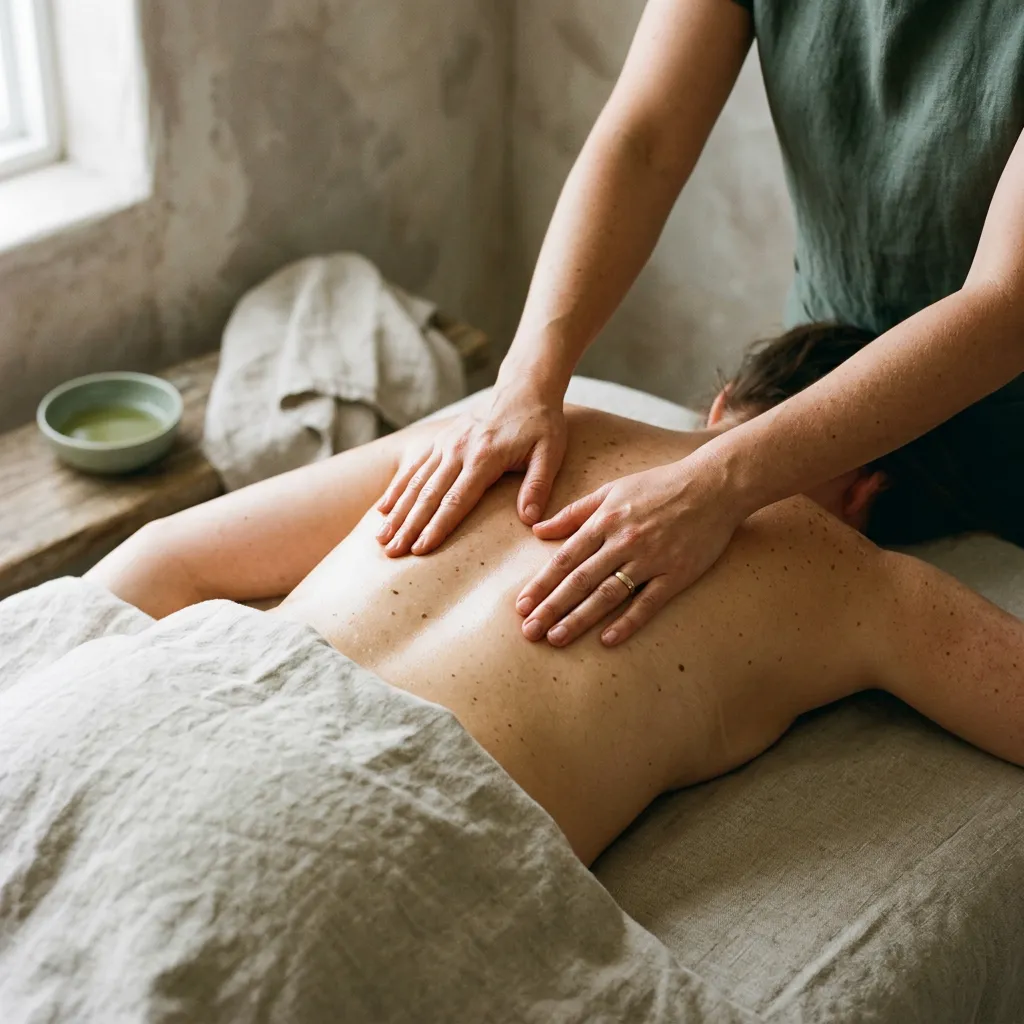
Deep tissue work means pressure applied along the direction of the muscle fibers, slow enough that the nervous system stops guarding and the tissue can actually let go. Your therapist usually warms the area first, then uses forearms, knuckles, and thumbs to hold steady pressure on the tight spots — the trigger points and adhesions that refer pain elsewhere. A knot at the base of the skull can drive a headache; a tight gluteal muscle can mimic sciatica down the leg. Finding and releasing those specific spots is the whole point.
Pressure is firm, but it is not the same as pain. The aim is the "good hurt" — a deep, satisfying ache that eases as the muscle releases. If you tense up or hold your breath, that is the signal to back off, and a skilled therapist reads that and adjusts. Several of our massage therapists carry continuing-education credentials in myofascial release, trigger-point therapy, and neuromuscular technique, so the pressure stays targeted rather than just hard.
Deep tissue is the second-most-requested service on our menu, just behind Swedish massage. The difference is intent: Swedish work is broad and relaxing, while deep tissue is slow and specific. Many clients alternate the two — Swedish to unwind, deep tissue to fix a recurring problem. For a fuller comparison, see our guide on choosing between deep tissue and Swedish massage.
Session Lengths & Pricing
Deep tissue is booked by time. For a single problem area, 30 minutes is enough; for back-and-neck or full-body chronic pain, choose 60 or 90 minutes so nothing gets skipped. The rate is the same whether the pressure is light or deep — there is no surcharge for the work itself.
| Session | Starting price | Best for |
|---|---|---|
| 30 minutes | from $60 | One focused area — lower back, neck, or shoulders |
| 60 minutes | most-booked option | Chronic back, neck, and shoulder pain together |
| 90 minutes | extended session | Full-body tension or layered, long-standing pain |
| Insurance copay | $15–$36 copay | Physician-referred work billed as medical massage |
With in-network billing for Providence, Regence and PacificSource, plus Moda, Kaiser, Aetna and United, a physician-referred deep tissue session for diagnosed chronic pain can run as low as a $15–$36 copay. For current 60- and 90-minute rates, contact our Newberg front desk; we are open Monday through Saturday 9am–8:30pm and Sunday 9am–7pm, so same-week appointments are the norm across our team of experienced therapists.
Conditions We Treat
Chronic Back Pain
Deep, targeted work along the spine and surrounding muscles to relieve persistent lower and upper back pain.
Neck & Shoulder Tension
Focused techniques to release the deep knots and trigger points that develop from desk work and poor posture.
Sciatica
Strategic deep tissue pressure on the piriformis and surrounding muscles to reduce sciatic nerve compression and radiating leg pain.
Sports Injuries
Rehabilitation-focused massage to speed recovery from strains, sprains, and overuse injuries common in active lifestyles.
Tension Headaches
Deep tissue release of muscle tightness in the neck, shoulders, and base of the skull that contributes to recurring headaches.
Limited Mobility
Breaking down fascial adhesions and scar tissue that restrict range of motion and cause stiffness in joints.
What the Research Says
Massage is a recognized complementary option for back and neck pain, and the honest picture is "helpful, mostly short-term," not a cure. Low-back pain is nearly universal — the National Center for Complementary and Integrative Health reports that about 80 percent of adults have it at some point. In its review of complementary approaches for low-back pain, NCCIH points to a 2015 analysis of 25 studies with about 3,000 participants that found massage may produce short-term improvements in pain. Pain lasting 12 weeks or longer is defined as chronic, which is exactly the pattern most of our deep tissue clients describe.
Dosing seems to matter. The agency's clinical digest on what the science says about massage describes a 2014 randomized controlled trial of 228 people with chronic neck pain in which 60-minute massages given several times a week worked better than shorter or less frequent sessions — one reason we steer neck and back clients toward the 60-minute appointment and a regular cadence rather than a one-off. The same digest cites a 2017 review of seven trials (352 participants) finding low- to moderate-quality evidence that massage beats inactive care for arthritis-related pain and function.
The safety record is reassuring: NCCIH notes the risk of harm from massage is low when it is performed by a trained practitioner, with rare serious effects mostly tied to very vigorous work or higher-risk clients. That is one more reason deep tissue belongs in skilled hands. Massage is meant to work alongside your medical care, not replace it — keep your doctor in the loop, especially if pain is new, severe, or radiating down a limb.
What to Expect & How to Recover
A first deep tissue visit runs from intake to aftercare in about an hour. Your therapist confirms the goal, has you settle face-down or however the target area is easiest to reach, and starts broad before going deep. You stay in control of the pressure the whole time. Once the session is done, a little aftercare protects the gains:
- Drink plenty of water for the rest of the day to help the body clear what the work releases.
- Expect a day or two of mild, workout-style soreness, especially after a first deep session.
- Apply ice to any tender spots for 10–15 minutes if an area feels overworked.
- Move gently — a short walk or light stretching keeps the loosened tissue from tightening back up.
- Skip strenuous workouts for 24 hours so the muscles can settle.
If a problem keeps coming back, a standing appointment usually beats waiting for the next flare-up. Our front desk can help you set a cadence that fits the research and your schedule.
Why Choose Oregon Massage & Spa?
Deep tissue is the second-most-booked modality on our menu, just behind Swedish, and several of our therapists hold continuing-education credentials specifically in myofascial release, trigger-point therapy, and neuromuscular technique. Sessions start at $60 (30 min), with most chronic-pain clients booking 60- or 90-minute slots. With in-network billing for Providence, Regence and PacificSource, plus Moda, Kaiser, Aetna and United, a physician-referred deep tissue session for diagnosed chronic pain can run as low as $15–$36 copay. Same-week availability is the norm because we keep a full team of experienced therapists, not a 2-person operation. 4.8 stars across 558+ reviews and Best of 2025–2026 BusinessRate honors.
Deep Tissue Massage in Newberg: The Numbers
Deep tissue is the same rate ladder as our relaxation work — what changes is the pace and the depth, not the price. The numbers below cover session lengths, how often regulars come in, and what the research says about how long the relief lasts.
| Established | 2008 — over 17 years of experience in Newberg, Oregon |
|---|---|
| Client rating | 4.8 out of 5 stars from 558+ reviews |
| Session lengths | 30, 45, 60, 75, 90 and 120 minutes |
| Rates from | $60 for 30 minutes · $85 for 60 minutes · $125 for 90 minutes |
| Open | Monday–Saturday 9:00 AM – 8:30 PM · Sunday 9:00 AM – 7:00 PM |
| Address | 901 Brutscher St 208 (second floor), Newberg, OR 97132 |
| Phone | (503) 538-0100 |
| Add-ons | Hot Stone +$20 · Aromatherapy complimentary · Cupping +$30 |
| Insurance | Oregon personal injury protection (PIP), workers' comp, health savings account (HSA) and flexible spending account (FSA) cards · medical massage $15–$36 copay |
| Areas served | Newberg, Oregon (OR), plus six nearby cities: Dundee and McMinnville in wine country, Sherwood and Wilsonville a short drive away, and Tigard and Tualatin toward Portland |
| Deep tissue rates | 30 min $60 · 45 min $70 · 60 min $85 · 75 min $100 · 90 min $125 · 120 min $180 |
| Session choice | 90 minutes when two or more areas need attention |
| Typical cadence | Every 1 to 2 weeks while working through a chronic area |
| Soreness | Mild for 24 to 48 hours after deeper work is normal |
Session lengths and rates
The full rate ladder, in the same order the booking page lists it. Every service is priced per session with no membership or contract.
| Service | Session lengths | Rates |
|---|---|---|
| Swedish / Relaxation Massage | 30 min / 45 min / 60 min / 75 min / 90 min / 120 min | $60 / $70 / $85 / $100 / $125 / $180 |
| Deep Tissue Massage | 30 min / 45 min / 60 min / 75 min / 90 min / 120 min | $60 / $70 / $85 / $100 / $125 / $180 |
| Couples Massage | 60 min / 75 min / 90 min / 120 min | $170 / $200 / $250 / $360 |
| Prenatal Massage | 60 min / 75 min / 90 min | $110 / $135 / $160 |
| Reflexology Foot & Body Combo | 75 min / 100 min | $110 / $145 |
| CBD Massage | 60 min / 90 min | $100 / $130 |
| Medical Massage | 60 / 90 min with referral | $15–$36 copay |
| Auto Accident (PIP) Massage | 30 / 60 / 90 min | $0 self-pay |
Sources and Further Reading
The health claims on this page come from public, non-commercial sources rather than our own marketing, and each link goes to the original so you can read the wording yourself. Massage is complementary support for comfort and tension — it is not a treatment for a diagnosed condition, and the sources below say so plainly.
- 1. NCCIH — Massage Therapy: What You Need To Know — the National Center for Complementary and Integrative Health overview of what massage is and what the research does and does not show.
- 2. NCCIH — Low-Back Pain and Complementary Health Approaches — what the reviews conclude about massage for low-back pain, including the short duration of the effect.
- 3. NCCIH — Chronic Pain and Complementary Health Approaches — usefulness and safety of non-drug approaches for long-running pain.
- 4. AMTA — Massage can improve health and wellness — the professional association's position statement, with its supporting citations.
Deep Tissue Massage FAQ
Does deep tissue massage hurt?
What conditions can deep tissue massage help with?
How is deep tissue different from Swedish massage?
How many deep tissue sessions will I need?
How should I prepare for a deep tissue massage?
Will I be sore after a deep tissue massage?
Related Services
Areas We Serve
Begin Your Journey
Ready to Feel Your Best?
Book your massage at Oregon Massage & Spa Newberg today. We are open seven days a week, Monday through Sunday. Walk-ins are welcome, but an appointment secures your preferred time.
Plan your Newberg massage
Need a massage today?
How to check same-day openings and ask about walk-in availability.
Evenings & weekends
Plan an after-work, Saturday or Sunday appointment in Newberg.
Compare services & prices
60-minute Swedish or deep tissue massage $85; couples $170 for two.
Massage gift certificates
Choose a gift, compare session budgets and plan the recipient's visit.